

Vishwakarma Puja honours Lord Vishwakarma, revered in Hindu tradition as the divine architect and craftsman of the gods. The festival is best known today as the day when workshops, factories and offices pause to worship their tools and machines, but its story is much older. Its roots lie in the Vedas, its legends grew in the epics and Puranas, and its present form took shape among artisans, craft communities and, in modern times, industrial workers across India.
Vishvakarman in the Rigveda
The name Vishvakarman means "the maker of all" or "the one whose work is everything". In the Rigveda, two hymns of the tenth mandala are addressed to Vishvakarman, who is praised as the all-maker: the one who fashioned heaven and earth, who sees in every direction and who gave form and name to the other gods. In these early hymns Vishvakarman is less a craftsman than a cosmic creator, closely linked with Prajapati, the lord of creatures.
Over time this abstract idea of the creator as a master builder gave way to a more personal figure: a divine craftsman who designs and builds for the gods. Both ideas survive in the way devotees speak of him today, as the creator of the world and as the patron of everyone who makes things with skill.
The architect of the gods in the epics and Puranas
In the epics and Puranas, Lord Vishwakarma becomes the deva-shilpi, the craftsman of the gods. The Mahabharata praises him with titles such as lord of the arts, maker of a thousand crafts, carpenter of the gods and the most eminent of artisans. According to tradition, his creations include:
- Dwarka, the city of Lord Krishna, built by the sea.
- The golden city of Lanka, which later became the capital of Ravana.
- The Pushpaka Vimana, the celebrated flying chariot.
- The Vajra, Indra's thunderbolt, made from the bones of the sage Dadhichi, who gave his life so that the gods could defeat the demon Vritra.
- Divine weapons and palaces of many gods, each believed to carry special powers.
Another well-known story concerns his daughter Sanjna (also called Saranyu), who was married to Surya, the sun god. Unable to bear her husband's blazing radiance, she left his home. According to tradition, Lord Vishwakarma then trimmed some of Surya's brilliance, and from the glowing fragments he fashioned celestial weapons, including the Sudarshana discus of Lord Vishnu and the trident of Lord Shiva. The Vishwakarma Puja katha, read on the day of the puja, tells further stories of his glory and of the devotees who worshipped him.
Popular tradition also links his work to the different ages (yugas): the heavenly realm (Swarga) in the Satya Yuga, Lanka in the Treta Yuga and Dwarka in the Dwapara Yuga. In these stories he appears as the builder behind several of the great cities of sacred history.
How Lord Vishwakarma is depicted
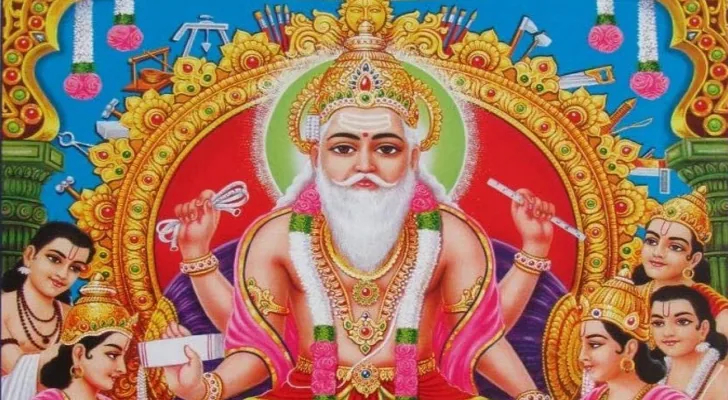
In paintings and idols, Lord Vishwakarma is usually shown with four arms and a white beard, a sign of age and wisdom. His hands hold the instruments of his work, such as a measuring rod or scale, a water pot, a book and a noose. His vehicle is a swan (hamsa). In Bengal and much of eastern India, he is often shown with an elephant, a youthful face and a more regal look. Each form reflects the same idea: knowledge, measurement and skill brought together in the act of creation.
From craft communities to factory floors
For centuries, carpenters, blacksmiths, metalworkers, stonemasons, goldsmiths and other artisans have looked on Lord Vishwakarma as their patron, and many craft communities regard him as their ancestor. Their worship of tools on a fixed day each year grew from a simple belief: the skill in a craftsman's hands, and the tools that serve it, are gifts that deserve respect.
As India's mills, railways, mines, factories and workshops grew, this festival of artisans became the festival of the working world. Engineers, architects, mechanics, machine operators, drivers, electricians, welders and factory workers adopted it as their own. Today it is especially popular in West Bengal, Odisha, Jharkhand, Bihar, Assam and Tripura, and workplaces across the country mark it in some form. The beliefs behind this devotion are explored further on the beliefs behind Vishwakarma Puja page.
Why the festival falls in September
In eastern India and much of the country, Vishwakarma Puja is observed on Kanya Sankranti, the day the sun enters Kanya (Virgo) in the sidereal solar calendar. Because it follows the sun rather than the moon, the date is nearly fixed, usually 16, 17 or 18 September. In parts of North India, such as Punjab, Haryana, Delhi and Himachal Pradesh, Vishwakarma Day is observed on the day after Diwali, alongside Govardhan Puja, and some communities observe Vishwakarma Jayanti on Magha Shukla Trayodashi. The Vishwakarma Puja date page lists the dates for the coming years.
How the tradition lives on
The way the day is kept still reflects its long history. Tools, machines and vehicles are cleaned and decorated, and work usually stops for the day. Factories and workshops set up pandals with an image or idol of Lord Vishwakarma, and workers and their families gather for a community puja. Tools are given tilak, flowers and akshat, the katha is heard, the aarti "Om Jai Shri Vishwakarma" is sung and prasad is shared among everyone. In Bengal and Bihar the sky fills with kites. The full method is described in the Vishwakarma Puja vidhi.
Frequently asked questions
Is Vishwakarma mentioned in the Vedas?
Yes. Vishvakarman is praised as the all-maker in two hymns of the tenth mandala of the Rigveda, where he appears as a cosmic creator rather than a craftsman.
Did Lord Vishwakarma build the assembly hall of the Pandavas?
No. The famous assembly hall of the Pandavas at Indraprastha, the Mayasabha, is credited to Maya, the architect of the asuras. Lord Vishwakarma is credited with Dwarka, Lanka and many divine weapons and chariots.
Why do workers celebrate Vishwakarma Puja?
Because Lord Vishwakarma is revered as the patron of all who create with skill. Worshipping him and their tools is a way for workers to give thanks for their livelihood and to pray for safe and successful work.
विश्वकर्मा पूजा भगवान विश्वकर्मा को समर्पित है, जिन्हें हिंदू परंपरा में देवताओं के दिव्य वास्तुकार और शिल्पी के रूप में पूजा जाता है। आज यह पर्व मुख्य रूप से उस दिन के रूप में जाना जाता है जब कारखाने, कार्यशालाएं और दफ़्तर काम रोककर अपने औज़ारों और मशीनों की पूजा करते हैं, लेकिन इसकी कहानी बहुत पुरानी है। इसकी जड़ें वेदों में हैं, इसकी कथाएं महाकाव्यों और पुराणों में विकसित हुईं, और इसका आज का रूप कारीगरों, शिल्पी समुदायों और आधुनिक काल में देशभर के औद्योगिक श्रमिकों के बीच बना।
ऋग्वेद में विश्वकर्मा
विश्वकर्मा नाम का अर्थ है "सब कुछ रचने वाला" या "जिसका कर्म ही सारा विश्व है"। ऋग्वेद के दसवें मंडल के दो सूक्त विश्वकर्मा को समर्पित हैं, जिनमें सर्वस्रष्टा के रूप में उनकी स्तुति की गई है: वे जिन्होंने आकाश और पृथ्वी की रचना की, जो सब दिशाओं में देखते हैं और जिन्होंने दूसरे देवताओं को नाम और रूप दिया। इन प्रारंभिक सूक्तों में विश्वकर्मा किसी शिल्पी से अधिक एक ब्रह्मांडीय सृष्टिकर्ता हैं, जिनका संबंध प्रजापति से जोड़ा जाता है।
समय के साथ सृष्टिकर्ता को एक महान निर्माता के रूप में देखने का यह विचार एक अधिक साकार रूप में बदला: ऐसे दिव्य शिल्पी, जो देवताओं के लिए नगर, भवन और अस्त्र बनाते हैं। भक्त आज भी दोनों भावों से उनका स्मरण करते हैं, संसार के रचयिता के रूप में भी और हर कुशल कारीगर के संरक्षक के रूप में भी।
महाकाव्यों और पुराणों में देवशिल्पी
महाकाव्यों और पुराणों में भगवान विश्वकर्मा देवशिल्पी, यानी देवताओं के शिल्पकार बन जाते हैं। महाभारत में उन्हें कलाओं के स्वामी, हज़ार शिल्पों के कर्ता, देवताओं के बढ़ई और कारीगरों में श्रेष्ठ जैसी उपाधियों से सराहा गया है। परंपरा के अनुसार उनकी रचनाओं में ये शामिल हैं:
- द्वारका, समुद्र तट पर बसी भगवान श्रीकृष्ण की नगरी।
- सोने की लंका, जो आगे चलकर रावण की राजधानी बनी।
- पुष्पक विमान, प्रसिद्ध आकाशगामी रथ।
- वज्र, इंद्र का अस्त्र, जो महर्षि दधीचि की अस्थियों से बना। दधीचि ने अपने प्राण इसलिए त्यागे ताकि देवता वृत्रासुर को पराजित कर सकें।
- अनेक देवताओं के दिव्य अस्त्र और महल, जिनमें विशेष शक्तियां मानी जाती हैं।
एक प्रसिद्ध कथा उनकी पुत्री संज्ञा (जिन्हें सरण्यू भी कहा जाता है) से जुड़ी है, जिनका विवाह सूर्यदेव से हुआ था। पति का प्रचंड तेज सहन न कर पाने के कारण वे उनका घर छोड़कर चली गईं। परंपरा के अनुसार तब भगवान विश्वकर्मा ने सूर्य के तेज का कुछ अंश कम किया और उसी तेज के अंशों से दिव्य अस्त्र बनाए, जिनमें भगवान विष्णु का सुदर्शन चक्र और भगवान शिव का त्रिशूल भी माने जाते हैं। पूजा के दिन पढ़ी जाने वाली विश्वकर्मा पूजा कथा में उनकी महिमा और उनकी पूजा करने वाले भक्तों की और कथाएं मिलती हैं।
लोक परंपरा उनके कार्यों को अलग-अलग युगों से भी जोड़ती है: सतयुग में स्वर्गलोक, त्रेता युग में लंका और द्वापर युग में द्वारका। इन कथाओं में वे पवित्र इतिहास के कई महान नगरों के निर्माता के रूप में सामने आते हैं।
भगवान विश्वकर्मा का स्वरूप
चित्रों और मूर्तियों में भगवान विश्वकर्मा प्रायः चार भुजाओं और सफ़ेद दाढ़ी के साथ दिखाए जाते हैं, जो आयु और ज्ञान का प्रतीक है। उनके हाथों में उनके काम के साधन होते हैं, जैसे नापने का दंड या तराज़ू, जल का कलश, पुस्तक और पाश। उनका वाहन हंस है। बंगाल और पूर्वी भारत के बड़े हिस्से में उन्हें अक्सर हाथी के साथ, युवा मुख और राजसी रूप में दिखाया जाता है। हर रूप एक ही भाव प्रकट करता है: ज्ञान, माप और कौशल का सृजन में मेल।
शिल्पी समुदायों से कारखानों तक
सदियों से बढ़ई, लोहार, धातु के कारीगर, पत्थर तराशने वाले, सुनार और अन्य कारीगर भगवान विश्वकर्मा को अपना संरक्षक मानते आए हैं, और कई शिल्पी समुदाय उन्हें अपना पूर्वज मानते हैं। साल में एक निश्चित दिन औज़ारों की पूजा करने की उनकी परंपरा एक सरल विश्वास से निकली: कारीगर के हाथों का हुनर और उसकी सेवा करने वाले औज़ार, दोनों ईश्वर की देन हैं और सम्मान के अधिकारी हैं।
जैसे-जैसे भारत में मिलें, रेलवे, खदानें, कारखाने और कार्यशालाएं बढ़ीं, कारीगरों का यह पर्व पूरे कामकाजी जगत का पर्व बन गया। इंजीनियरों, वास्तुकारों, मैकेनिकों, मशीन चलाने वालों, ड्राइवरों, बिजली मिस्त्रियों, वेल्डरों और कारखाने के श्रमिकों ने इसे अपना लिया। आज यह पश्चिम बंगाल, ओडिशा, झारखंड, बिहार, असम और त्रिपुरा में विशेष रूप से लोकप्रिय है, और देशभर के कार्यस्थल इसे किसी न किसी रूप में मनाते हैं। इस श्रद्धा के पीछे की मान्यताओं के बारे में विश्वकर्मा पूजा से जुड़ी मान्यताएं पेज पर और जानें।
यह पर्व सितंबर में क्यों आता है
पूर्वी भारत और देश के बड़े हिस्से में विश्वकर्मा पूजा कन्या संक्रांति के दिन होती है, जब नाक्षत्र सौर पंचांग के अनुसार सूर्य कन्या राशि में प्रवेश करते हैं। चूंकि यह चंद्रमा के बजाय सूर्य की गति पर आधारित है, इसलिए इसकी तारीख लगभग तय रहती है, आमतौर पर 16, 17 या 18 सितंबर। उत्तर भारत के कुछ हिस्सों, जैसे पंजाब, हरियाणा, दिल्ली और हिमाचल प्रदेश में, विश्वकर्मा दिवस दिवाली के अगले दिन गोवर्धन पूजा के साथ मनाया जाता है, और कुछ समुदाय माघ शुक्ल त्रयोदशी को विश्वकर्मा जयंती मनाते हैं। आने वाले वर्षों की तिथियां विश्वकर्मा पूजा की तिथि पेज पर दी गई हैं।
आज यह परंपरा कैसे जीवित है
इस दिन को मनाने का ढंग आज भी इसके लंबे इतिहास की झलक देता है। औज़ारों, मशीनों और वाहनों की सफ़ाई करके उन्हें सजाया जाता है और आमतौर पर उस दिन काम बंद रहता है। कारखानों और कार्यशालाओं में भगवान विश्वकर्मा की प्रतिमा या चित्र के साथ पंडाल सजते हैं, और श्रमिक अपने परिवारों के साथ सामूहिक पूजा में शामिल होते हैं। औज़ारों पर तिलक लगाकर फूल और अक्षत चढ़ाए जाते हैं, कथा सुनी जाती है, "ॐ जय श्री विश्वकर्मा" आरती गाई जाती है और सबमें प्रसाद बांटा जाता है। बंगाल और बिहार में आसमान पतंगों से भर जाता है। पूरी विधि विश्वकर्मा पूजा विधि में दी गई है।
अक्सर पूछे जाने वाले प्रश्न
क्या वेदों में विश्वकर्मा का उल्लेख है?
हां। ऋग्वेद के दसवें मंडल के दो सूक्तों में विश्वकर्मा की सर्वस्रष्टा के रूप में स्तुति की गई है, जहां वे शिल्पी के बजाय ब्रह्मांड के रचयिता के रूप में दिखते हैं।
क्या पांडवों का सभा भवन भगवान विश्वकर्मा ने बनाया था?
नहीं। इंद्रप्रस्थ में पांडवों की प्रसिद्ध सभा, मयसभा, असुरों के शिल्पी मय ने बनाई थी। भगवान विश्वकर्मा को द्वारका, लंका और अनेक दिव्य अस्त्रों और रथों का निर्माता माना जाता है।
श्रमिक विश्वकर्मा पूजा क्यों मनाते हैं?
क्योंकि भगवान विश्वकर्मा हर उस व्यक्ति के संरक्षक माने जाते हैं जो कौशल से कुछ रचता है। उनकी और अपने औज़ारों की पूजा करके श्रमिक अपनी आजीविका के लिए आभार प्रकट करते हैं और सुरक्षित व सफल काम की प्रार्थना करते हैं।