

Vishwakarma Puja honours Lord Vishwakarma, revered as the divine architect and craftsman of the gods and the patron of artisans, engineers, mechanics and industrial workers. What sets it apart from most pujas is that the tools, machines and vehicles people work with are worshipped alongside the deity. This page gives an overview of the procedure: who performs it, the order the puja follows, and how it differs at home and at a workplace. For the detailed steps with mantras, see the Vishwakarma Puja vidhi.
When the puja is performed
In eastern India and in most workplaces, Vishwakarma Puja is performed on Kanya Sankranti, the day the sun enters Kanya (Virgo), which usually falls on 16, 17 or 18 September. In parts of North India, such as Punjab, Haryana and Delhi, Vishwakarma Day is observed on the day after Diwali, and some communities also mark Vishwakarma Jayanti in the month of Magha. The puja is usually held in the morning or at the time your priest or local panchang recommends. See the Vishwakarma Puja date for the year.
Who performs the puja
- At a workplace, the owner or the senior-most person usually sits as the yajman (the host of the puja), often with their spouse. Many factories invite a priest to conduct the rituals, while workers take part in the tool worship, the aarti and the prasad.
- At home, the head of the family or any adult member can perform the puja. A priest is not essential; the puja can be done with simple offerings and the name mantra "Om Vishwakarmane Namah".
- Individual craftspeople, such as carpenters, tailors, blacksmiths, electricians, mechanics and drivers, often worship their own tools or vehicles themselves.
Everyone taking part bathes and wears clean clothes, and many people fast until the puja is complete, as a personal choice.
The order of the puja
Customs vary by region and family, but the puja generally follows this order:
- Bath and clean clothes. The person performing the puja bathes in the morning and wears clean or new clothes.
- Cleaning the workplace and tools. The premises, tools, machines and vehicles are cleaned, usually a day before, and the machines are switched off. See Vishwakarma Puja preparation.
- Setting up the altar. A chowki covered with a yellow or red cloth is placed on a clean spot, often in front of a rangoli or an eight-petalled lotus alpana, and the picture or idol of Lord Vishwakarma is placed on it. The place and the samagri are purified by sprinkling water, and a ghee lamp is lit.
- Sankalp. Holding water, akshat, a flower and a coin, the yajman states their name, the place, the occasion and the purpose of the puja. A raksha sutra (mauli) is tied on the wrist.
- Ganesh puja. Lord Ganesh is worshipped first, as at the start of every Hindu ritual.
- Kalash sthapana. A kalash filled with water, with five mango leaves and a coconut on top, is placed beside the altar.
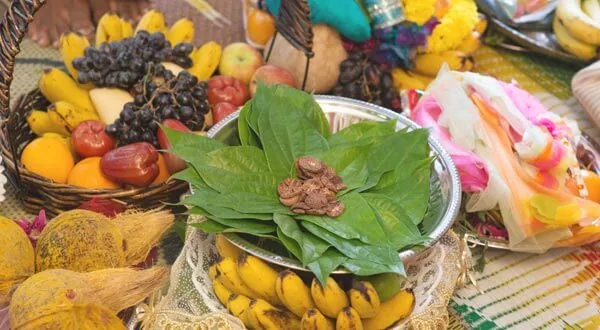
- Worship of Lord Vishwakarma. The Lord is invoked and offered water, sandalwood, roli, akshat, flowers and garlands, incense, the lamp, fruit, sweets and panchamrit.
- Worship of tools and machines. Each tool, machine and vehicle receives a tilak of roli or sindoor, flowers and akshat, and sometimes a mauli thread.
- Katha. The Vishwakarma Puja katha is read or heard.
- Aarti. Everyone joins in the aarti "Om Jai Shri Vishwakarma", followed by pushpanjali (offering flowers with folded hands).
- Havan (in some places). Many factories and priest-led pujas include a havan with offerings of ghee and havan samagri. Some priests perform it before the final aarti.
- Prasad. Prasad is offered to the Lord and then shared with everyone present, often followed by a community meal. Dakshina is given to the priest.
Vishwakarma Puja at home
At home the puja is usually short and simple. A framed picture is placed on a small chowki, and the household tools and machines, such as a sewing machine, kitchen appliances, a computer, a bicycle or the family car, are cleaned and worshipped together. A kalash, a lamp, incense, flowers, fruit and sweets are enough. The family reads the katha, sings the aarti and shares the prasad. Many households also pray for the safety of family members who work with machines or travel daily.
Vishwakarma Puja at a workplace
In factories, workshops, garages, printing presses and construction sites, the puja is a community event. A larger idol is often installed, sometimes in a decorated pandal, especially in West Bengal, Odisha, Jharkhand, Bihar and Assam. Work stops for the day and the machines are switched off, cleaned and decorated with flowers. After the main puja, the priest and the owner go round the premises worshipping each major machine where it stands. Vehicles such as trucks, buses, taxis and auto-rickshaws are washed, garlanded and given a tilak. The day usually ends with prasad, a shared meal and, in many workplaces, gifts or a bonus for the workers. In Bengal and Bihar, kite flying is a popular part of the day.
After the puja
Where a clay idol has been installed, it is usually kept until the next day, and some families keep a lamp burning beside it through the night; if you do this at a workplace, make sure someone stays to watch the flame. The idol is then immersed (visarjan), along with the flowers and other offerings, often in a procession. Many towns now ask devotees to immerse idols in designated tanks, and some families immerse small idols in a bucket of water at home, which is kinder to rivers and ponds. A framed picture stays in place and needs no visarjan. Work and machines usually resume the following day.
Belief behind the puja
Devotees believe that worshipping Lord Vishwakarma and the tools of one's trade brings blessings for skill, safe work and prosperity in business. For many workers, the day is also a way of giving thanks to the machines and tools that support their livelihood throughout the year.
विश्वकर्मा पूजा भगवान विश्वकर्मा को समर्पित है, जिन्हें देवताओं का दिव्य वास्तुकार और शिल्पी तथा कारीगरों, इंजीनियरों, मिस्त्रियों और औद्योगिक कामगारों का आराध्य माना जाता है। अधिकांश पूजाओं से इसकी अलग पहचान यह है कि इसमें भगवान के साथ-साथ उन औज़ारों, मशीनों और वाहनों की भी पूजा होती है जिनसे लोग काम करते हैं। इस पृष्ठ पर पूजा की प्रक्रिया का सार दिया गया है: पूजा कौन करता है, पूजा किस क्रम में होती है, और घर तथा कार्यस्थल की पूजा में क्या अंतर है। मंत्रों सहित विस्तृत चरणों के लिए विश्वकर्मा पूजा विधि देखें।
पूजा कब होती है
पूर्वी भारत में और अधिकांश कार्यस्थलों पर विश्वकर्मा पूजा कन्या संक्रांति को होती है, यानी जिस दिन सूर्य कन्या राशि में प्रवेश करते हैं, जो प्रायः 16, 17 या 18 सितंबर को पड़ता है। पंजाब, हरियाणा और दिल्ली जैसे उत्तर भारत के कुछ हिस्सों में विश्वकर्मा दिवस दिवाली के अगले दिन मनाया जाता है, और कुछ समुदाय माघ महीने में विश्वकर्मा जयंती भी मनाते हैं। पूजा सामान्यतः सुबह या पुरोहित अथवा स्थानीय पंचांग द्वारा बताए गए समय पर होती है। उस वर्ष की विश्वकर्मा पूजा तिथि देखें।
पूजा कौन करता है
- कार्यस्थल पर सामान्यतः मालिक या सबसे वरिष्ठ व्यक्ति यजमान बनकर बैठते हैं, अक्सर अपने जीवनसाथी के साथ। कई कारखाने पूजा कराने के लिए पुरोहित बुलाते हैं, और कर्मचारी औज़ार पूजन, आरती और प्रसाद में भाग लेते हैं।
- घर पर परिवार का मुखिया या कोई भी वयस्क सदस्य पूजा कर सकता है। पुरोहित ज़रूरी नहीं है; सरल सामग्री और नाम मंत्र "ॐ विश्वकर्मणे नमः" से भी पूजा की जा सकती है।
- अकेले काम करने वाले कारीगर, जैसे बढ़ई, दर्ज़ी, लोहार, बिजली मिस्त्री, मैकेनिक और ड्राइवर, अक्सर अपने औज़ारों या वाहनों की पूजा स्वयं करते हैं।
पूजा में भाग लेने वाले सभी लोग स्नान करके साफ़ कपड़े पहनते हैं, और बहुत से लोग अपनी इच्छा से पूजा पूरी होने तक उपवास रखते हैं।
पूजा का क्रम
क्षेत्र और परिवार के अनुसार परंपराएँ अलग हो सकती हैं, पर पूजा सामान्यतः इस क्रम में होती है:
- स्नान और स्वच्छ वस्त्र। पूजा करने वाला व्यक्ति सुबह स्नान करके साफ़ या नए कपड़े पहनता है।
- कार्यस्थल और औज़ारों की सफ़ाई। परिसर, औज़ार, मशीनें और वाहन प्रायः एक दिन पहले साफ़ कर लिए जाते हैं और मशीनें बंद कर दी जाती हैं। देखें विश्वकर्मा पूजा की तैयारी।
- वेदी की स्थापना। साफ़ जगह पर पीले या लाल कपड़े से ढकी चौकी रखी जाती है, अक्सर रंगोली या अष्टदल कमल की अल्पना के सामने, और उस पर भगवान विश्वकर्मा की तस्वीर या प्रतिमा स्थापित की जाती है। जल छिड़ककर स्थान और सामग्री को शुद्ध किया जाता है और घी का दीपक जलाया जाता है।
- संकल्प। हाथ में जल, अक्षत, फूल और सिक्का लेकर यजमान अपना नाम, स्थान, अवसर और पूजा का उद्देश्य बोलते हैं। कलाई पर रक्षासूत्र (मौली) बाँधा जाता है।
- गणेश पूजन। हर हिंदू अनुष्ठान की तरह सबसे पहले भगवान गणेश की पूजा होती है।
- कलश स्थापना। जल से भरा कलश, जिसके मुख पर आम के पाँच पत्ते और नारियल रखे हों, वेदी के पास स्थापित किया जाता है।
- भगवान विश्वकर्मा का पूजन। भगवान का आवाहन करके उन्हें जल, चंदन, रोली, अक्षत, फूल और माला, धूप, दीप, फल, मिठाई और पंचामृत अर्पित किए जाते हैं।
- औज़ारों और मशीनों की पूजा। हर औज़ार, मशीन और वाहन पर रोली या सिंदूर का तिलक लगाया जाता है, फूल और अक्षत चढ़ाए जाते हैं, और कहीं-कहीं मौली बाँधी जाती है।
- कथा। विश्वकर्मा पूजा कथा पढ़ी या सुनी जाती है।
- आरती। सब मिलकर "ॐ जय श्री विश्वकर्मा" आरती गाते हैं, और फिर पुष्पांजलि (हाथ जोड़कर फूल अर्पित करना) होती है।
- हवन (कुछ स्थानों पर)। कई कारखानों और पुरोहित द्वारा कराई जाने वाली पूजाओं में घी और हवन सामग्री की आहुतियों के साथ हवन होता है। कुछ पुरोहित इसे अंतिम आरती से पहले कराते हैं।
- प्रसाद। प्रसाद पहले भगवान को अर्पित किया जाता है और फिर सभी उपस्थित लोगों में बाँटा जाता है, जिसके बाद अक्सर सामूहिक भोज होता है। पुरोहित को दक्षिणा दी जाती है।
घर पर विश्वकर्मा पूजा
घर पर पूजा प्रायः छोटी और सरल होती है। छोटी चौकी पर फ़्रेम की हुई तस्वीर रखी जाती है, और घर के औज़ार और मशीनें, जैसे सिलाई मशीन, रसोई के उपकरण, कंप्यूटर, साइकिल या परिवार की कार, साफ़ करके साथ में पूजी जाती हैं। कलश, दीपक, अगरबत्ती, फूल, फल और मिठाई पर्याप्त हैं। परिवार कथा पढ़ता है, आरती गाता है और प्रसाद बाँटता है। बहुत से परिवार उन सदस्यों की सुरक्षा के लिए भी प्रार्थना करते हैं जो मशीनों के साथ काम करते हैं या रोज़ यात्रा करते हैं।
कार्यस्थल पर विश्वकर्मा पूजा
कारखानों, वर्कशॉप, गैराज, छापेखानों और निर्माण स्थलों पर यह पूजा सामूहिक उत्सव होती है। अक्सर बड़ी प्रतिमा स्थापित की जाती है, कभी-कभी सजे हुए पंडाल में, ख़ासकर पश्चिम बंगाल, ओडिशा, झारखंड, बिहार और असम में। उस दिन काम बंद रहता है और मशीनें बंद करके, साफ़ करके फूलों से सजाई जाती हैं। मुख्य पूजा के बाद पुरोहित और मालिक परिसर में घूमकर हर बड़ी मशीन की उसकी जगह पर पूजा करते हैं। ट्रक, बस, टैक्सी और ऑटो-रिक्शा जैसे वाहन धोकर माला पहनाए जाते हैं और उन पर तिलक लगाया जाता है। दिन का समापन प्रायः प्रसाद, सामूहिक भोज और कई कार्यस्थलों पर कर्मचारियों को उपहार या बोनस देने से होता है। बंगाल और बिहार में इस दिन पतंग उड़ाना भी लोकप्रिय है।
पूजा के बाद
जहाँ मिट्टी की प्रतिमा स्थापित की गई हो, उसे प्रायः अगले दिन तक रखा जाता है, और कुछ परिवार रात भर उसके पास दीपक जलाए रखते हैं; कार्यस्थल पर ऐसा करें तो कोई व्यक्ति लौ की देखरेख के लिए वहाँ रहे। इसके बाद प्रतिमा का फूलों और अन्य चढ़ावे के साथ विसर्जन किया जाता है, अक्सर शोभायात्रा के साथ। अब कई शहरों में प्रतिमाओं के विसर्जन के लिए अलग कुंड बनाए जाते हैं, और कुछ परिवार छोटी प्रतिमा को घर पर ही पानी की बाल्टी में विसर्जित करते हैं, जो नदियों और तालाबों के लिए बेहतर है। फ़्रेम की हुई तस्वीर अपनी जगह रहती है, उसका विसर्जन नहीं होता। काम और मशीनें सामान्यतः अगले दिन से फिर शुरू होती हैं।
पूजा के पीछे की मान्यता
श्रद्धालु मानते हैं कि भगवान विश्वकर्मा और अपने काम के औज़ारों की पूजा करने से कौशल, सुरक्षित कामकाज और व्यवसाय में समृद्धि का आशीर्वाद मिलता है। बहुत से कामगारों के लिए यह दिन उन मशीनों और औज़ारों के प्रति आभार जताने का भी अवसर है, जो सालभर उनकी आजीविका का सहारा बनते हैं।