

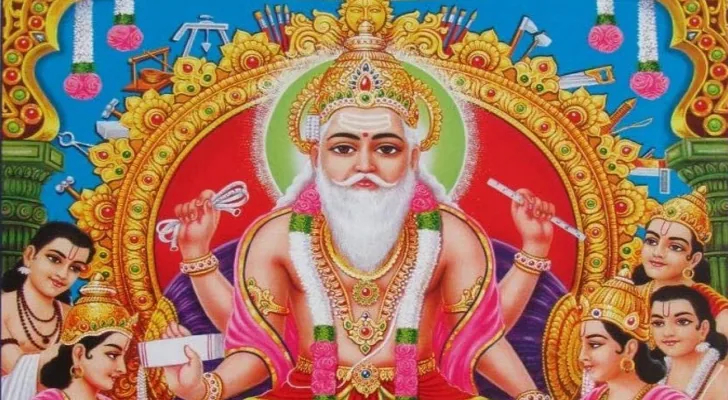
The Vishwakarma Puja katha is the sacred story read or heard on the day of Vishwakarma Puja. It tells how Lord Vishnu revealed his Vishwakarma form, the divine architect and maker of the universe, and how sages, kings, craftsmen and merchants found relief by worshipping him. The story is narrated by Suta (Sutji), the knower of the Puranas, to an assembly of sages, and it is divided into five chapters (adhyaya).
The katha is usually read after the main worship and before the Vishwakarma aarti, by a priest or an elder, while everyone sits and listens with folded hands. In the story itself the vow is kept on Amavasya (the new moon day); today the main festival falls on Kanya Sankranti, but the katha is read in the same way. Below is the full story, chapter by chapter.
Chapter 1: Lord Vishnu reveals his Vishwakarma form
Once, many sages gathered at Kurukshetra, the field of dharma, and put a question to Suta, who understood the deep meaning of the Puranas. The sages said: "O wise one, learned in the Puranas, a doubt has suddenly arisen in our minds; please explain it and remove it. We have heard of the many forms of Lord Vishnu, whose radiance is beyond compare, but we do not know which of them is the greatest. Kindly tell us this secret."
Suta said: "O sages, you have asked a most auspicious question for the good of the world, and it gives me great joy. Lord Vishnu, the master of the universe whom the whole world worships, has many forms. Listen with respect as I describe the highest of them. By remembering it, even great sinners have been freed from their sins; there is no doubt about this. The very same question was once asked of Lord Vishnu by Goddess Lakshmi in the ocean of milk (Kshira Sagar)."
Lakshmi said: "O Lord of the world, your devotees on earth worship your many forms with devotion. Are all these forms equal, or is there a difference among them, some being chief and others secondary?"
Lord Vishnu said to Lakshmi: "Beloved, when, together with my Yogamaya, I have gathered the whole universe back into myself and then wish to become many, I create in a single moment countless worlds in which living beings may experience the fruits of their actions. Listen carefully as I describe the form in which I do this. O Devi, I take the form of Vishwakarma, shining on every side like many suns. Then, wishing to create human beings, I first create Brahma, the great ascetic."
"To Brahma I teach the Rigveda, the Yajurveda and the Samaveda, which reveal hymns of praise, the rites of sacrifice and sacred song. In the same way I give the Atharvaveda, which sets out the knowledge of crafts (shilpa vidya), and through it craftsmen have made a great many things. O great goddess, of all my forms this is the chief, the one that built the whole of creation in an instant. Whoever meditates on this wonderful form even for a moment has all obstacles destroyed, and the craftsman who meditates on Lord Vishwakarma is freed from all sorrow."
Here ends the first chapter.
Chapter 2: Sage Angira's search for peace
Suta said: Having described his form to Lakshmi in this way, Lord Vishnu, master of the three worlds, fell silent.
The sages said: "O great Suta, best of speakers, you who know every dharma: how did you come to know this wonderful secret? How did this form come to be worshipped and become known throughout the world?"
Suta replied: "O sages, listen to this account, which brings good to the whole land, just as I heard it. There was a sage named Angira who practised austerities on the bank of the Ganga near the Himalaya. In the rainy season he sat out in the open, in winter he stood in icy water, and in summer he sat in the blazing sun. Yet his mind found no peace, and he ran here and there like a thirsty deer."
Then suddenly a voice spoke from the sky: "O ascetic, you have strayed from your goal and are labouring in vain. Just as an arrow that misses its mark cannot strike the target, so it is with you, and people laugh at you. Worship and meditate on Lord Vishwakarma, the creator and destroyer, renowned in the world and the giver of what is desired, the radiant one with five faces and ten arms, who is worshipped by Saraswati and by Lakshmi herself. Lord Vishnu himself described this form to me in the ocean of milk, and even now the thought of it makes my body thrill. On the day of Amavasya, set aside all other work and worship him with the proper rites."
Hearing the voice from the sky, Sage Angira was at first full of doubt, but then he sat in meditation. As he meditated on Lord Vishwakarma, a whole treasury of the science of crafts (shilpa shastra) opened in his mind, together with the knowledge of the Atharvaveda and its meaning. With his own understanding, this sage who knew the truth went on to invent the vimana (aerial chariot) and many other things.
Suta continued: "By the grace of Lord Vishwakarma the world became happy, for through his grace the knowledge of making carts, chariots and other things spread. From that time this form of Lord Vishwakarma became famous in the world, and the story came down to me through the line of tradition. O sages, whoever hears this katha gains knowledge simply by listening. This form of great light works for the good of the whole world, and the katha calls the person who does not worship and remember him ungrateful."
Here ends the second chapter.
Chapter 3: King Pramangad and Queen Kamala
The sages said: "O Suta, having heard from you the story of Lord Vishwakarma, our hearts are still not satisfied, just as the gods are never satisfied with nectar. Our wish to hear more grows the way a fire grows when offerings are poured into it."
Suta said: "Best of sages, listen attentively to the beautiful story of Lord Vishwakarma, teacher of the world and embodiment of truth, consciousness and bliss. Long ago there was a king named Pramangad who cared for his subjects as if they were his own sons. Giving up idleness, he devoted himself to righteous work. He ruled his people with love and never by the sword. He did not wish to rule over people crushed by poverty; he was always absorbed in making his subjects happy. He believed that giving charity to the unworthy was the same as protecting the wicked, and so, with no ungrateful or wicked people to trouble it, his kingdom was content."
His queen was named Kamala. She had eyes like a lotus, was as virtuous as Sati herself, was learned, and had deep faith in righteous deeds and religious vows. But by misfortune this righteous king, the protector of his people, was struck by kushtha (leprosy), a disease that caused him great suffering. Many treatments were tried, but the disease would not go, and the king was deeply unhappy.
Here the sages interrupted: "How could such a noble king, who ruled according to dharma, suffer such a disease? If even the righteous fall ill like this, who in the world will put their faith in dharma?"
Suta said: "In earlier days this king had spread the views of the unbelievers. He taught people that the world has no beginning and that no one, not Vishwakarma nor anyone else, created it. But if Vishwakarma, who gives the world the fruits of its actions, did not exist, how could a person who helps others receive the merit of that good deed? And if those who do good received no reward, why would anyone help another? The world would fall apart. That is why those who mislead others in this way surely receive punishment. And have no doubt about this: the fruits of the good and bad deeds of many lifetimes are not all received in a single life. Now listen carefully to the rest of the story."
Seeing the king so distressed, the queen spoke to him with a heavy heart. The queen said: "O King, even our radiant family priest Upamanyu once went blind from a disease of the eyes. Using his wisdom, he decided to keep a fast on Amavasya and worship Lord Vishwakarma. On the day of the puja he ate only a single meal of fruit in the evening, set aside all other work and began to worship Lord Vishwakarma. By the power of that vow he was given divine sight, and even now, in his old age, his sight remains as good as ever. Great King, I humbly pray that you too take refuge in Lord Vishwakarma, the protector of the helpless."
The king said: "My dear, you have spoken rightly. Hearing this, my heart is filled with enthusiasm, and I feel sure that by the grace of Lord Vishwakarma this effort will succeed. The very eagerness of my heart tells me so."
Suta said: From that day the king set aside all other work and worshipped Lord Vishwakarma on every Amavasya. By the power of that worship, the katha says, he was soon freed from the disease, his body became radiant like gold, and he ruled happily. From then on he stayed absorbed at the lotus feet of Lord Vishwakarma like a bee at a lotus, and never forgot him. According to the katha, whoever lovingly meditates on and worships Lord Vishwakarma every day with faith and devotion is freed from all ills and in the end attains liberation (moksha).
Here ends the third chapter.
The healings in this chapter belong to the story and to devotional belief. This is not a substitute for medical advice; if you are unwell, please consult a doctor.
Chapter 4: The chariot-maker of Varanasi
Suta said again: "O sages, I have told you of the wonderful deeds of Lord Vishwakarma. Now I will describe another account that will amaze the world. In the town of Varanasi there lived a chariot-maker (rathkar) with his wife, a man who lived by the righteous ways of the world. He was learned and skilled at his work, yet he wandered anxiously in search of a living. Though he roamed and strove like a jackal searching for food, he could never earn more than enough to eat."
His wife, like her husband, was always worried, for they had no son, and she wondered how they would manage in old age. Anxious for a child, she went to monasteries to seek the blessings of their heads. Sometimes she even went to bearded frauds; in short, she went to every kind of holy man without telling true from false. Yet in spite of all kinds of charms, spells and rituals, her wish was not fulfilled. Her state was like that of a doe that runs through fields of kasha and kusha grass, or over the sands of the Yamuna, mistaking a mirage for water.
One trickster would wave peacock feathers over her, another would write a yantra on birch bark (bhojpatra), and calling themselves tantriks and exorcists they would say, "Such-and-such a deity comes upon me; he will fulfil your wish," and hand her sacred ash. In this way the husband and wife were deeply unhappy in their longing for a child. Seeing them caught in the great web of these tricksters, a Brahmin who lived next door spoke to them.
The Brahmin said: "O chariot-maker, why do you wander here and there for the sake of a child? You seem to me very foolish. Such false remedies will never bring a child or wealth; all this effort is wasted. Those who try to fulfil their wishes by such false means are great fools, for useless effort never succeeds. Even more foolish are those who believe that the spells and fire rituals of exorcists will give their children long life, for children raised in such ways do not gain good understanding."
"So give up these useless remedies and take refuge in the most compassionate Lord Vishwakarma alone. By his grace your work will surely succeed; without his grace no one is freed from suffering. Lord Vishwakarma is free in granting the fruits of actions, giving joy and sorrow sooner or later. Even if your present hardship is the result of past misdeeds, Lord Vishwakarma can surely lift you out of it, for he is all-powerful and cares for his sincere devotees. God gives the fruits of actions in many ways; making someone childless or poor is not his only means. Therefore, on the day of Amavasya, set aside all other work, keep a fast, worship Lord Vishwakarma, listen to the account of his glory, and spend what you can on helping others."
Hearing this teaching from the noble Brahmin, the chariot-maker's eyes were opened. He bowed at the feet of the kind Brahmin and went home meditating on Lord Vishwakarma. From that day the good chariot-maker meditated on the lotus feet of Shri Vishwakarma, and his wife too gave up false remedies and turned with devotion to the Lord's virtues.
By keeping the Amavasya vow with the proper rites, the chariot-maker very soon became prosperous and was blessed with a son. From then on not a single day passed without income. Their son grew up well-mannered, gifted and learned, performed his daily sandhya prayers, and was deeply devoted to his parents. So the husband and wife lived happily, following the duties of householders. The katha says that whoever worships and meditates on Lord Vishwakarma lives happily all their life with their spouse and children.
Here ends the fourth chapter.
Chapter 5: The merchant of Ujjain and Sage Lomash
Suta said: "O great sages, I will tell you once more of the glory of Lord Vishwakarma, renowned throughout the world. Listen attentively. In the city of Ujjain there lived a respected, generous and righteous merchant (seth). His treasury was always full of gems and precious stones, like the store of Kubera. There was hardly anyone around him who had not taken money from him, whether for a wedding, to fight a lawsuit or to escape illness and hardship."
Having spent his wealth on helping others, the merchant became poor and suffered like an elephant stuck in mud. He was fully confident that the friends he had helped would surely help him in return, but his hope was in vain. Not one of those ungrateful friends came forward. As soon as he lost his wealth, his friends turned into enemies within a few days and began to speak ill of him. His former friends would look away and walk past as soon as they saw him, for selfish friends do not stand by you in hard times.
The behaviour of such mean-spirited people filled the merchant with disgust and turned him away from the world. Scorning the ungrateful, he left his city and went into the forest. There he lived on roots, bulbs and fruit, and if by chance he saw another person, he would run far away in disgust.
One day, wandering on, the merchant reached a lonely forest and saw Sage Lomash sitting in a mountain cave in the lotus posture, practising austerities with a calm mind. The sage, as his name suggests, was covered in thick hair, and the merchant, taking him for an animal, went and sat near him out of curiosity. Seeing the merchant sitting close by, the sage asked, "Is all well with you? From where have your wanderings brought you here?"
The merchant was astonished to hear an "animal" speak in human language. When asked, he told the great sage his whole story from beginning to end. Hearing it, the sage said to him: "If you hate sinners and the ungrateful, why have you turned away from Lord Vishwakarma? O merchant, it is that very god who created you and gave you every joy you have enjoyed. He created the whole world and ordered it according to karma. How can you be happy if you abandon him? The unbeliever and the ungrateful person first forget God. So take refuge in the all-powerful Lord Vishwakarma."
"Lord Vishwakarma, maker of the world whose roots lie above, has many forms: with two arms, four arms and ten arms, and with one face, four faces and five faces. He has five sons named Manu, Maya, Tvashta, Shilpi and Daivajna. Of these, Manu works in iron, Maya in wood, and Tvashta in bronze and copper; Shilpi works in brick and stone, and Daivajna in gold and silver. These are the crafts of the five sons of Vishwakarma, and this work is regarded as sacred, as a kind of yajna."
"At the time of building the bridge to Lanka (Setu Bandhan), Lord Rama too worshipped Lord Vishwakarma, and when Dwarka was being built, Shri Krishna worshipped him as well. So you too should worship him; you will be freed from all your troubles and gain every kind of success."
The sage's teaching brought the merchant great peace, and from that day he became a devotee of Shri Vishwakarma. Through his worship all his sins were washed away, and in the end, the katha says, he attained a divine state and lived happily in heaven. Whoever meditates on Lord Vishwakarma with a devoted heart gains devotion to his lotus feet, and the wise person who listens to the holy fame of Shri Vishwakarma enjoys the happiness of this world and in the end reaches the eternal abode of Lord Vishwakarma.
Here ends the fifth chapter, and the Shri Vishwakarma Puja katha is complete.
Other stories of Lord Vishwakarma
The five chapters above form the vrat katha. Alongside it, devotees often tell other well-known stories of Lord Vishwakarma from the epics and Puranas. They are given here in brief, as they are told according to tradition.
Sanjna and Surya
Lord Vishwakarma's daughter Sanjna (also called Saranyu) was married to Surya, the sun god. Unable to bear her husband's blazing radiance, she left his home. To bring them together again, Lord Vishwakarma trimmed away part of Surya's brilliance, and from the glowing fragments he is said to have fashioned celestial weapons, including the discus of Lord Vishnu and the trident of Lord Shiva.
Indra's Vajra
When the demon Vritra troubled the gods, the sage Dadhichi gave up his life so that his bones could be used to make a weapon. From those bones Lord Vishwakarma fashioned the Vajra, the thunderbolt of Indra, with which Vritra was defeated.
Dwarka, Lanka and the Pushpaka Vimana
Tradition credits Lord Vishwakarma with the golden city of Lanka, which later became Ravana's capital, the Pushpaka Vimana, the celebrated flying chariot, and Dwarka, the city of Lord Krishna by the sea. This is why the fifth chapter of the katha says that Shri Krishna worshipped him when Dwarka was being built. The assembly hall of the Pandavas at Indraprastha, the Mayasabha, is credited to Maya rather than to Vishwakarma. More of this background is on the history of Vishwakarma Puja page.
The message of the katha
Each chapter carries a simple lesson. The first two chapters present Lord Vishwakarma as the creative power of the divine, the source of every skill, craft and invention, and Sage Angira's story shows that hard austerity without the right focus brings no peace. King Pramangad's story warns against pride and disbelief and shows the value of humble faith, while the queen's gentle advice reminds devotees that good counsel within a family can change a life.
The chariot-maker's story speaks directly to working people. It cautions against tricksters and false remedies, and its advice is practical as well as devotional: honest work, faith, regular worship and helping others as far as one can. The merchant of Ujjain shows that generosity should not turn into bitterness when others are ungrateful, and that turning back to God brings peace. Together, the chapters teach respect for work and for the tools of one's trade, which is the heart of Vishwakarma Puja.
After the katha, everyone sings the aarti "Om Jai Shri Vishwakarma", and many devotees also recite the Vishwakarma Chalisa. For the full order of worship, see the Vishwakarma puja vidhi.
विश्वकर्मा पूजा कथा वह पवित्र कथा है जो विश्वकर्मा पूजा के दिन पढ़ी या सुनी जाती है। इसमें बताया गया है कि भगवान विष्णु ने अपने विश्वकर्मा रूप का, यानी सृष्टि के दिव्य शिल्पी और रचयिता के रूप का, वर्णन कैसे किया, और किस प्रकार ऋषियों, राजाओं, कारीगरों और व्यापारियों ने उनकी पूजा से अपने कष्टों से मुक्ति पाई। यह कथा पुराणों के ज्ञाता श्री सूतजी ने ऋषियों की सभा में सुनाई थी और इसके पांच अध्याय हैं।
मुख्य पूजन के बाद और विश्वकर्मा आरती से पहले पुरोहित या घर के कोई बड़े-बुजुर्ग कथा पढ़ते हैं और सभी लोग हाथ जोड़कर श्रद्धा से सुनते हैं। कथा में व्रत अमावस्या के दिन रखा गया है; आजकल मुख्य पर्व कन्या संक्रांति को मनाया जाता है, पर कथा उसी प्रकार पढ़ी जाती है। नीचे पांचों अध्यायों की पूरी कथा क्रम से दी गई है।
पहला अध्याय: भगवान विष्णु द्वारा विश्वकर्मा रूप का वर्णन
एक समय धर्मक्षेत्र कुरुक्षेत्र में बहुत से ऋषि एकत्र हुए और उन्होंने पुराणों का मर्म जानने वाले धर्मज्ञ श्री सूतजी से प्रश्न किया। ऋषियों ने कहा: "हे पुराणों में निपुण महाभाग! हमारे मन में अचानक एक संदेह उत्पन्न हो गया है, कृपया उसे समझाकर दूर कीजिए। हमने अतुल तेजस्वी भगवान विष्णु के अनेक रूपों का वर्णन सुना है, किंतु यह नहीं जानते कि उनमें सर्वश्रेष्ठ कौन-सा है। कृपा करके हमें यह रहस्य बताइए।"
श्री सूतजी ने कहा: "हे मुनियो! आप लोगों ने संसार के हित के लिए अत्यंत शुभ प्रश्न पूछा है, इससे मुझे बड़ी प्रसन्नता है। जगत के स्वामी और सारे संसार द्वारा पूजित भगवान विष्णु के अनेक रूप हैं। उनमें जो सर्वश्रेष्ठ रूप है, उसे आदरपूर्वक सुनिए। उसके स्मरण मात्र से बड़े-बड़े पापी भी पापमुक्त हो गए, इसमें कोई संदेह नहीं है। यही प्रश्न एक बार क्षीर सागर में माता लक्ष्मी ने भगवान विष्णु से पूछा था।"
लक्ष्मीजी ने कहा: "हे जगन्नाथ! पृथ्वी पर भक्तजन आपके अनेक रूपों की भक्तिपूर्वक पूजा करते हैं। हे स्वामी! क्या वे सब रूप समान हैं, या उनमें मुख्य और गौण का भेद भी है?"
भगवान विष्णु ने लक्ष्मीजी से कहा: "हे प्रिये! जब मैं योगमाया के साथ पूरे ब्रह्मांड को अपने भीतर समेट लेता हूं और फिर अनेक रूप धारण करने की इच्छा करता हूं, तब जीवों को अपने कर्मों का फल भोगने के लिए मैं क्षण भर में असंख्य लोकों की रचना करता हूं। जिस रूप से मैं यह रचना करता हूं, उसका वर्णन करता हूं, ध्यान से सुनो। हे देवि! चारों ओर प्रकाश फैलाता हुआ, अनेक सूर्यों के समान चमकने वाला मैं विश्वकर्मा का रूप धारण करता हूं। फिर मनुष्यों की सृष्टि की इच्छा से सबसे पहले तपस्वी ब्रह्मा को रचता हूं।"
"उन ब्रह्मा को मैं स्तुति, यज्ञ और गान का ज्ञान देने वाले ऋग्वेद, यजुर्वेद और सामवेद का उपदेश देता हूं। इसी प्रकार शिल्प विद्या का प्रतिपादन करने वाला अथर्ववेद भी प्रदान करता हूं, जिसके द्वारा शिल्पियों ने अनेक वस्तुओं की रचना की है। हे महेश्वरि! सब रूपों में यही मुख्य रूप है, जिसने क्षण भर में सारी सृष्टि का निर्माण किया। जो मनुष्य इस अद्भुत रूप का क्षण भर भी ध्यान करता है, उसके सब विघ्न नष्ट हो जाते हैं, और जो शिल्पी भगवान विश्वकर्मा का ध्यान करता है, उसका सारा दुख दूर हो जाता है।"
इस प्रकार पहला अध्याय समाप्त हुआ।
दूसरा अध्याय: महर्षि अंगिरा की शांति की खोज
सूतजी ने कहा: इस प्रकार तीनों लोकों के स्वामी भगवान विष्णु लक्ष्मीजी से अपने रूप का वर्णन करके मौन हो गए।
ऋषियों ने कहा: "हे सब धर्मों के ज्ञाता, वक्ताओं में श्रेष्ठ महात्मा सूतजी! आपने यह अद्भुत रहस्य कैसे जाना? यह रूप संसार में कैसे पूजित हुआ और कैसे प्रचलित हुआ?"
श्री सूतजी ने उत्तर दिया: "हे मुनियो! देश का कल्याण करने वाला यह वृत्तांत मैंने जैसा सुना, वैसा ही सुनिए। अंगिरा नाम के एक महर्षि थे, जो हिमालय के निकट गंगा तट पर बैठकर तपस्या किया करते थे। वर्षा ऋतु में वे खुले आकाश के नीचे बैठते, जाड़े में ठंडे जल में खड़े रहते और गर्मी में धूप में बैठकर तप करते थे। फिर भी उनके मन को शांति नहीं मिली और वे प्यासे हिरण की तरह इधर-उधर भटकने लगे।"
तभी अचानक आकाशवाणी हुई: "हे तपोधन! तुम अपने लक्ष्य से भटककर व्यर्थ श्रम कर रहे हो। जैसे निशाने से चूका हुआ बाण लक्ष्य को नहीं भेद सकता, वैसी ही दशा तुम्हारी है, और लोग तुम्हारा उपहास कर रहे हैं। तुम सृष्टि की उत्पत्ति और संहार करने वाले, संसार में विख्यात, मनोवांछित फल देने वाले, पांच मुख और दस भुजाओं वाले महातेजस्वी भगवान विश्वकर्मा की पूजा और ध्यान करो, जिनकी पूजा सरस्वती और स्वयं महारानी लक्ष्मी करती हैं। इस रूप का वर्णन स्वयं भगवान विष्णु ने क्षीर सागर में मुझसे किया था, जिसके ध्यान से आज भी शरीर रोमांचित हो जाता है। अमावस्या के दिन सब काम छोड़कर विधिपूर्वक उनकी पूजा करो।"
यह आकाशवाणी सुनकर अंगिरा मुनि पहले तो संदेह में पड़े, फिर ध्यान में बैठ गए। भगवान विश्वकर्मा का ध्यान करते ही उनके मन में शिल्पशास्त्र का पूरा भंडार खुल गया और उन्हें अर्थ सहित अथर्ववेद का ज्ञान हो गया। तत्त्व को जानने वाले इन्हीं मुनि अंगिरा ने अपनी बुद्धि से विमान आदि अनेक वस्तुओं का आविष्कार किया।
सूतजी ने आगे कहा: "भगवान विश्वकर्मा की कृपा से ही यह संसार सुखी हुआ, क्योंकि उन्हीं की कृपा से गाड़ी, रथ आदि बनाने के ज्ञान का प्रसार हुआ। तभी से भगवान विश्वकर्मा का यह रूप संसार में प्रसिद्ध हुआ और परंपरा से यह कथा मुझ तक पहुंची। हे मुनियो! जो मनुष्य इस कथा को सुनता है, उसे सुनने मात्र से ज्ञान प्राप्त होता है। यह महाज्योति का रूप संसार का हित करने वाला है, और कथा के अनुसार जो इनका पूजन और स्मरण नहीं करता, वह कृतघ्न है।"
इस प्रकार दूसरा अध्याय समाप्त हुआ।
तीसरा अध्याय: राजा प्रमंगद और रानी कमला
ऋषियों ने कहा: "हे सूतजी! आपसे भगवान विश्वकर्मा का चरित्र सुनकर भी हमारे मन की तृप्ति नहीं हो रही, जैसे देवताओं को अमृत से कभी तृप्ति नहीं होती। भगवान का चरित्र सुनने की हमारी इच्छा वैसे ही बढ़ रही है, जैसे आहुति देने से अग्नि बढ़ती है।"
सूतजी ने कहा: "हे मुनिश्रेष्ठो! जगद्गुरु, सच्चिदानंद भगवान विश्वकर्मा की यह सुंदर कथा ध्यान से सुनिए। प्राचीन काल में प्रमंगद नाम के एक राजा थे, जो अपनी प्रजा का पालन अपने पुत्रों की तरह करते थे। आलस्य छोड़कर वे सदा धर्म के कार्य करते थे। वे प्रजा पर प्रेम से शासन करते थे, तलवार के बल पर कभी नहीं। दरिद्रता से दुखी लोगों पर राज करना उनकी नीति नहीं थी; वे हमेशा प्रजा को सुखी बनाने में लगे रहते थे। अपात्र को दान देना वे दुष्ट की रक्षा करने के समान मानते थे, इसलिए कृतघ्न और दुष्ट लोगों के न होने से उनका राज्य सुखी था।"
उनकी पत्नी का नाम कमला था। वे कमल के समान नेत्रों वाली, साक्षात सती के समान, विदुषी और धर्म-कर्म तथा व्रत-उपवास में गहरी श्रद्धा रखने वाली थीं। दुर्भाग्य से प्रजा का पालन करने वाले उस धर्मात्मा राजा को कुष्ठ रोग हो गया, जो उन्हें बहुत कष्ट देता था। अनेक उपचार करने पर भी रोग दूर नहीं हुआ और राजा बहुत दुखी रहने लगे।
यहां ऋषियों ने पूछा: "धर्म के अनुसार शासन करने वाले ऐसे महात्मा राजा को यह रोग कैसे हुआ? जब ऐसे धर्मात्माओं को भी रोग हो जाता है, तो संसार में धर्म पर कौन विश्वास करेगा?"
सूतजी ने कहा: "यह राजा पहले नास्तिक मत का प्रचार करता था। वह लोगों को उपदेश देता था कि यह संसार अनादि है और इसका रचयिता विश्वकर्मा या कोई और नहीं है। पर यदि संसार को कर्मों का फल देने वाले विश्वकर्मा न हों, तो दूसरों का उपकार करने वाला मनुष्य पुण्य का फल कैसे पाएगा? और यदि परोपकारी को पुण्य का फल न मिले, तो कोई किसी का उपकार क्यों करेगा? ऐसा होने पर संसार नष्ट हो जाएगा। इसीलिए ऐसे पाखंड फैलाने वालों को दंड अवश्य मिलता है। और इसमें कोई संदेह नहीं कि अनेक जन्मों के पाप और पुण्य का सारा फल एक ही जन्म में नहीं मिलता। अब आगे की कथा ध्यान से सुनिए।"
राजा को बहुत दुखी देखकर रानी ने भारी मन से कहा। रानी ने कहा: "हे राजन! हमारे महातेजस्वी पुरोहित उपमन्युजी भी आंखों के रोग से अंधे हो गए थे। उन्होंने अपने ज्ञान के बल पर अमावस्या के दिन व्रत रखकर भगवान विश्वकर्मा की पूजा करना उचित समझा। पूजा के दिन उन्होंने शाम को एक बार फलाहार किया और सब काम छोड़कर भगवान विश्वकर्मा की पूजा आरंभ की। उसी व्रत के प्रभाव से उन्हें दिव्य दृष्टि प्राप्त हुई और आज वृद्धावस्था में भी उनकी दृष्टि ज्यों-की-त्यों है। हे महाराज! मैं विनम्रता से प्रार्थना करती हूं कि आप भी दीनों के पालक भगवान विश्वकर्मा की शरण में जाएं।"
राजा ने कहा: "प्रिये! तुमने ठीक कहा। यह सुनकर मेरे मन में बड़ा उत्साह हो रहा है और मुझे विश्वास है कि भगवान विश्वकर्मा की कृपा से यह प्रयास अवश्य सफल होगा। मन का यह उत्साह ही इसका संकेत है।"
सूतजी ने कहा: उसी दिन से राजा सब काम छोड़कर हर अमावस्या को भगवान विश्वकर्मा का पूजन करने लगे। कथा के अनुसार पूजन के प्रभाव से वे शीघ्र ही कुष्ठ रोग से मुक्त हो गए, उनका शरीर सोने के समान दिव्य हो गया और वे सुखपूर्वक राज्य करने लगे। उस समय से राजा भगवान विश्वकर्मा के चरण-कमलों में भौंरे की तरह लीन रहने लगे और उन्हें कभी नहीं भूले। कथा कहती है कि जो मनुष्य प्रतिदिन प्रेम, श्रद्धा और भक्ति से भगवान विश्वकर्मा का ध्यान और पूजन करता है, वह सब कष्टों से मुक्त होकर अंत में मोक्ष पद प्राप्त करता है।
इस प्रकार तीसरा अध्याय समाप्त हुआ।
इस अध्याय में रोग दूर होने का वर्णन कथा और आस्था का अंग है। यह चिकित्सा सलाह का विकल्प नहीं है; अस्वस्थ होने पर डॉक्टर से परामर्श लें।
चौथा अध्याय: वाराणसी का रथकार
सूतजी ने फिर कहा: "हे मुनियो! मैंने आप लोगों को भगवान विश्वकर्मा का अद्भुत चरित्र सुनाया। अब संसार को चकित करने वाला एक और वृत्तांत सुनाता हूं। वाराणसी नगरी में संसार के धार्मिक आचरण के अनुसार जीवन बिताने वाला एक रथकार अपनी पत्नी के साथ रहता था। वह अपने काम में निपुण और विद्वान था, फिर भी जीविका के लिए व्याकुल होकर इधर-उधर घूमता रहता था। भोजन की खोज में भटकते सियार की तरह घूम-घूमकर प्रयत्न करने पर भी वह पेट भरने से अधिक धन नहीं कमा पाता था।"
उसकी पत्नी भी पति की तरह सदा चिंतित रहती थी, क्योंकि उनके कोई पुत्र नहीं था और उसे यह चिंता थी कि बुढ़ापा कैसे कटेगा। संतान की चिंता में वह मठों में जाकर महंतों से आशीर्वाद लेती थी। कभी-कभी वह दाढ़ी-मूंछ वाले धूर्तों के पास भी चली जाती थी; यानी सच्चे-झूठे का भेद किए बिना वह हर तरह के साधु-संतों के पास जाती थी। पर तरह-तरह के तंत्र-मंत्र और उपाय करने पर भी उसकी कामना पूरी नहीं हुई। उसकी दशा उस हिरणी जैसी थी जो कभी कास-कुश के जंगलों में और कभी यमुना की रेत पर पानी के भ्रम में दौड़ती फिरती है।
कोई धूर्त मोर के पंख घुमाता, कोई भोजपत्र पर यंत्र लिखता, और अपने को तांत्रिक और ओझा बताकर कहता: "मुझ पर अमुक देवता आते हैं, वे तुम्हारा मनोरथ पूरा कर देंगे," और फिर भभूत दे देता। इस प्रकार संतान की चिंता में पति-पत्नी दोनों बहुत दुखी रहते थे। उन्हें धूर्तों के बड़े माया-जाल में फंसते देखकर एक पड़ोसी ब्राह्मण ने उनसे कहा।
ब्राह्मण ने कहा: "हे रथकार! संतान के लिए तुम इधर-उधर क्यों भटकते हो? मुझे तो तुम बड़े नासमझ लगते हो। ऐसे झूठे उपायों से कभी संतान या धन नहीं मिल सकता; यह सारा परिश्रम व्यर्थ है। जो लोग ऐसे झूठे उपायों से अपने मनोरथ पूरे करना चाहते हैं, वे महामूर्ख हैं, क्योंकि व्यर्थ के उद्योग से कोई काम सफल नहीं होता। उनसे भी अधिक मूर्ख वे हैं जो समझते हैं कि ओझाओं के झाड़-फूंक और अग्नि-ज्वाला से उनके बच्चे दीर्घायु होंगे, क्योंकि ऐसे वातावरण में पले बच्चों को अच्छी बुद्धि नहीं मिलती।"
"इसलिए तुम व्यर्थ के उपाय छोड़कर केवल परम दयालु भगवान विश्वकर्मा की शरण में जाओ। उनकी कृपा से तुम्हारा काम अवश्य सफल होगा; उनकी कृपा के बिना कोई भी कष्ट से मुक्त नहीं हो सकता। कर्मों का फल देने में भगवान विश्वकर्मा स्वतंत्र हैं और समय के अनुसार सुख और दुख देते हैं। यदि तुम्हारी यह दुर्दशा पिछले कुकर्मों का फल भी हो, तो भी भगवान विश्वकर्मा तुम्हें इससे अवश्य उबार सकते हैं, क्योंकि वे सर्वशक्तिमान हैं और अपने निष्कपट भक्तों का ध्यान रखते हैं। ईश्वर के पास कर्मों का फल देने के अनेक साधन हैं; किसी को निःसंतान या निर्धन बनाना ही उनका एकमात्र साधन नहीं है। इसलिए अमावस्या के दिन सब काम छोड़कर व्रत रखो, भगवान विश्वकर्मा का पूजन करो, उनका माहात्म्य सुनो और अपनी शक्ति के अनुसार परोपकार में धन खर्च करो।"
महात्मा ब्राह्मण के मुख से यह उपदेश सुनकर रथकार की आंखें खुल गईं। परोपकारी ब्राह्मण के चरणों में प्रणाम करके वह भगवान विश्वकर्मा का ध्यान करता हुआ घर लौट गया। उस दिन से धर्मात्मा रथकार श्री विश्वकर्मा के चरण-कमलों का ध्यान करने लगा, और उसकी पत्नी भी झूठे उपाय छोड़कर भगवान के गुणों में भक्ति करने लगी।
अमावस्या के दिन विधि-विधान से व्रत करने से रथकार बहुत जल्दी धनवान हो गया और उसे पुत्र की प्राप्ति हुई। उस दिन से उसका एक भी दिन बिना आमदनी के नहीं गया। उसका पुत्र सुशील, गुणी और विद्वान हुआ, नियम से संध्या-वंदन करता था और माता-पिता का परम भक्त था। इस प्रकार पति-पत्नी दोनों गृहस्थ धर्म का पालन करते हुए सुख से जीवन बिताने लगे। कथा कहती है कि जो मनुष्य भगवान विश्वकर्मा का पूजन और ध्यान करता है, वह जीवन भर पत्नी और संतान के साथ सुखी रहता है।
इस प्रकार चौथा अध्याय समाप्त हुआ।
पांचवां अध्याय: उज्जैन का सेठ और लोमश मुनि
श्री सूतजी ने कहा: "हे महर्षियो! विश्व-विख्यात भगवान विश्वकर्मा का माहात्म्य मैं आप लोगों को फिर से सुनाता हूं, ध्यान से सुनिए। उज्जैन नगरी में एक प्रतिष्ठित, उदार बुद्धि वाला धर्मात्मा सेठ रहता था। उसका खजाना कुबेर के भंडार की तरह मणि-माणिक्य से सदा भरा रहता था। उसके आस-पास शायद ही कोई ऐसा व्यक्ति था जिसने विवाह के लिए, मुकदमा लड़ने के लिए या रोग और संकट से छुटकारे के लिए उससे धन न लिया हो।"
परोपकार में सारा धन खर्च हो जाने पर वह सेठ दरिद्र हो गया और कीचड़ में फंसे हाथी की तरह दुख पाने लगा। उसे पूरा भरोसा था कि जिन मित्रों की उसने सहायता की है, वे उसकी मदद अवश्य करेंगे, पर उसकी आशा व्यर्थ गई। कोई भी कृतघ्न मित्र उसकी सहायता के लिए आगे नहीं आया। धन जाते ही कुछ ही दिनों में मित्र शत्रु बन गए और उसकी निंदा करने लगे। पुराने मित्र उसे देखते ही आंख बचाकर निकल जाते, क्योंकि स्वार्थी मित्र विपत्ति में साथ नहीं देते।
ऐसे नीच स्वभाव वाले लोगों के व्यवहार से सेठ के मन में संसार के प्रति विरक्ति और घृणा भर गई। कृतघ्नों का तिरस्कार करते हुए वह अपना नगर छोड़कर जंगल में चला गया। वहां वह कंद-मूल और फल खाकर जीवन बिताने लगा, और यदि संयोग से कोई मनुष्य दिख जाता तो घृणा के कारण उसे देखते ही दूर भाग जाता।
एक दिन घूमते-घूमते सेठ एक निर्जन वन में पहुंचा और उसने देखा कि पर्वत की एक गुफा में लोमश मुनि पद्मासन लगाए शांत मन से तपस्या कर रहे हैं। मुनि का शरीर, उनके नाम के अनुसार, घने रोमों से ढका था, इसलिए सेठ उन्हें कोई पशु समझकर कौतूहल से उनके पास जाकर बैठ गया। सेठ को पास बैठा देखकर मुनि ने पूछा: "कुशल तो है? कहां से घूमते हुए यहां आए हो?"
जिसे वह पशु समझ रहा था, उसे मनुष्य की भाषा में बोलते सुनकर सेठ बड़े आश्चर्य में पड़ गया। पूछे जाने पर उसने आदि से अंत तक अपना सारा वृत्तांत महर्षि को सुना दिया। यह सुनकर मुनिवर ने सेठ से कहा: "यदि तुम्हें पापियों और कृतघ्नों से घृणा है, तो फिर तुम भगवान विश्वकर्मा से विमुख क्यों हो? हे सेठ! उसी देव ने तुम्हें रचा है और तुमने जो भी सुख भोगे हैं, वे उन्हीं के दिए हैं। उन्होंने सारे संसार की रचना करके कर्म के अनुसार उसकी व्यवस्था की है। उन्हें छोड़कर तुम कैसे सुखी हो सकते हो? नास्तिक और कृतघ्न मनुष्य सबसे पहले परमात्मा को भूलता है। इसलिए तुम सर्वशक्तिमान भगवान विश्वकर्मा की शरण में जाओ।"
"ऊर्ध्वमूल जगत के कर्ता भगवान विश्वकर्मा के अनेक रूप हैं: दो भुजाओं, चार भुजाओं और दस भुजाओं वाले, तथा एक मुख, चार मुख और पांच मुख वाले। उनके पांच पुत्र हैं, जिनके नाम मनु, मय, त्वष्टा, शिल्पी और दैवज्ञ हैं। इनमें मनु लोहे का, मय लकड़ी का और त्वष्टा कांसे और तांबे का काम करते हैं; शिल्पी ईंट और पत्थर का तथा दैवज्ञ सोने-चांदी का काम करते हैं। यही विश्वकर्मा के पांचों पुत्रों के कर्म हैं, और इस शिल्प कर्म को यज्ञ-कर्म के समान पवित्र माना जाता है।"
"सेतु-बंधन के समय भगवान श्रीराम ने भी भगवान विश्वकर्मा का पूजन किया था, और द्वारका के निर्माण के समय श्रीकृष्ण ने भी उनकी पूजा की थी। इसलिए तुम भी उनकी पूजा करो; तुम सब कष्टों से मुक्त होकर सब सिद्धियां प्राप्त करोगे।"
मुनि के उपदेश से सेठ को बहुत शांति मिली और उसी दिन से वह श्री विश्वकर्मा का भक्त बन गया। उनकी आराधना और पूजन से उसके सब पाप दूर हो गए, और कथा के अनुसार अंत में वह देवत्व प्राप्त करके स्वर्ग में सुख भोगने लगा। जो मनुष्य भक्ति भरे मन से भगवान विश्वकर्मा का ध्यान करता है, उसे उनके चरण-कमलों की भक्ति प्राप्त होती है, और जो बुद्धिमान मनुष्य श्री विश्वकर्मा का पवित्र यश सुनता है, वह पृथ्वी के सब सुख भोगकर अंत में भगवान विश्वकर्मा का शाश्वत पद प्राप्त करता है।
इस प्रकार पांचवां अध्याय समाप्त हुआ और श्री विश्वकर्मा पूजा कथा पूर्ण हुई।
भगवान विश्वकर्मा की अन्य कथाएं
ऊपर के पांच अध्याय व्रत कथा हैं। इनके साथ भक्त महाकाव्यों और पुराणों से भगवान विश्वकर्मा की कुछ और प्रसिद्ध कथाएं भी सुनाते हैं। परंपरा के अनुसार वे यहां संक्षेप में दी गई हैं।
संज्ञा और सूर्य
भगवान विश्वकर्मा की पुत्री संज्ञा (जिन्हें सरण्यू भी कहते हैं) का विवाह सूर्य देव से हुआ था। पति का प्रचंड तेज सहन न कर पाने के कारण वे उनका घर छोड़कर चली गईं। दोनों को फिर से मिलाने के लिए भगवान विश्वकर्मा ने सूर्य के तेज का कुछ अंश छांट दिया, और माना जाता है कि उन्हीं चमकते अंशों से उन्होंने दिव्य अस्त्र बनाए, जिनमें भगवान विष्णु का सुदर्शन चक्र और भगवान शिव का त्रिशूल भी हैं।
इंद्र का वज्र
जब वृत्रासुर ने देवताओं को सताया, तब महर्षि दधीचि ने अपने प्राण त्याग दिए ताकि उनकी अस्थियों से अस्त्र बन सके। उन्हीं अस्थियों से भगवान विश्वकर्मा ने इंद्र का वज्र बनाया, जिससे वृत्रासुर पराजित हुआ।
द्वारका, लंका और पुष्पक विमान
परंपरा सोने की लंका, जो बाद में रावण की राजधानी बनी, प्रसिद्ध पुष्पक विमान और समुद्र तट पर बसी भगवान श्रीकृष्ण की द्वारका नगरी के निर्माण का श्रेय भगवान विश्वकर्मा को देती है। इसीलिए कथा के पांचवें अध्याय में कहा गया है कि द्वारका के निर्माण के समय श्रीकृष्ण ने उनकी पूजा की थी। इंद्रप्रस्थ में पांडवों की सभा, मयसभा, का निर्माण विश्वकर्मा ने नहीं, बल्कि मय ने किया था। इससे जुड़ी और जानकारी विश्वकर्मा पूजा का इतिहास पेज पर है।
कथा का संदेश
हर अध्याय में एक सरल सीख छिपी है। पहले दो अध्याय भगवान विश्वकर्मा को ईश्वर की सृजन शक्ति के रूप में दिखाते हैं, जिनसे हर कौशल, शिल्प और आविष्कार का जन्म होता है। महर्षि अंगिरा की कथा बताती है कि सही दिशा के बिना कठोर तप से भी शांति नहीं मिलती। राजा प्रमंगद की कथा अहंकार और अविश्वास से सावधान करती है और विनम्र श्रद्धा का महत्व बताती है, और रानी की कोमल सलाह याद दिलाती है कि परिवार में दी गई अच्छी सलाह जीवन बदल सकती है।
रथकार की कथा सीधे कामकाजी लोगों से बात करती है। वह धूर्तों और झूठे उपायों से सावधान करती है, और उसकी सीख भक्ति के साथ-साथ व्यावहारिक भी है: ईमानदारी से काम, श्रद्धा, नियमित पूजा और अपनी शक्ति के अनुसार दूसरों की सहायता। उज्जैन के सेठ की कथा सिखाती है कि दूसरों की कृतघ्नता से उदारता कड़वाहट में नहीं बदलनी चाहिए, और ईश्वर की ओर लौटने से ही शांति मिलती है। कुल मिलाकर यह कथा काम और अपने काम के औज़ारों के सम्मान की सीख देती है, जो विश्वकर्मा पूजा का मूल भाव है।
कथा के बाद सब मिलकर "ॐ जय श्री विश्वकर्मा" आरती गाते हैं, और बहुत से भक्त विश्वकर्मा चालीसा का पाठ भी करते हैं। पूजा का पूरा क्रम जानने के लिए विश्वकर्मा पूजा विधि देखें।