

Below are five essays on Vishwakarma Puja for students and readers of all ages: a short 150-word essay, a 300-word essay, a longer school essay with headings, an essay on Lord Vishwakarma as the divine architect, and an essay on how the puja is celebrated at workplaces. Each can be used as it is or shortened to suit a class assignment or speech.
Short essay on Vishwakarma Puja (150 words)
Vishwakarma Puja is a Hindu festival dedicated to Lord Vishwakarma, the divine architect and craftsman of the gods. He is honoured as the patron deity of artisans, engineers, mechanics, factory workers and all who work with tools and machines.
The puja is usually observed on Kanya Sankranti, the day the sun enters the sign of Virgo, which usually falls on 16, 17 or 18 September. It is celebrated with special enthusiasm in West Bengal, Odisha, Jharkhand, Bihar, Assam and Tripura. In parts of North India, Vishwakarma Day is observed on the day after Diwali.
On this day, workshops, factories and offices are cleaned and decorated. Tools, machines and vehicles are worshipped, and work usually stops for the day. After the puja and aarti, prasad is shared among everyone. The festival teaches respect for work, skill and the tools that help people earn a living.
Essay on Vishwakarma Puja (300 words)
India celebrates many festivals, and each has its own meaning. Vishwakarma Puja is special because it honours work itself. It is dedicated to Lord Vishwakarma, who is revered as the architect and engineer of the gods and the patron deity of craftspeople and industrial workers.
According to tradition, Lord Vishwakarma built the city of Dwarka for Lord Krishna, the golden city of Lanka and the flying chariot Pushpaka Vimana. He is also believed to have made celestial weapons, including Indra's Vajra. In the Rigveda, Vishvakarman is praised as the all-maker in two hymns of the tenth mandala.
Vishwakarma Puja is usually observed on Kanya Sankranti, which generally falls on 16, 17 or 18 September. Because the date follows the solar calendar, it stays nearly the same every year. The festival is most popular in eastern India, especially in West Bengal, Odisha, Jharkhand, Bihar, Assam and Tripura, and is observed in factories and workshops across the country. In Punjab, Haryana, Delhi and Himachal Pradesh, many people observe Vishwakarma Day on the day after Diwali, along with Govardhan Puja.
Preparations begin with cleaning. Workplaces, tools and machines are washed, oiled and decorated with flowers. A picture or idol of Lord Vishwakarma is placed on a chowki, and the puja is performed with flowers, incense, a lamp, fruits and sweets. Workers apply tilak to their tools and machines and offer flowers and akshat. The katha is read, the aarti "Om Jai Shri Vishwakarma" is sung and prasad is distributed. In Bengal and Bihar, flying kites is a popular part of the day.
The festival is a reminder that every kind of work deserves respect. It encourages care for tools, safety at work and a sense of unity among people who work together.
Vishwakarma Puja essay for school students
Introduction
Vishwakarma Puja is a Hindu festival in honour of Lord Vishwakarma, the divine architect. It is one of the few festivals in which tools, machines and workplaces are worshipped, and it is loved by workers, engineers and craftspeople across India.
Who is Lord Vishwakarma?
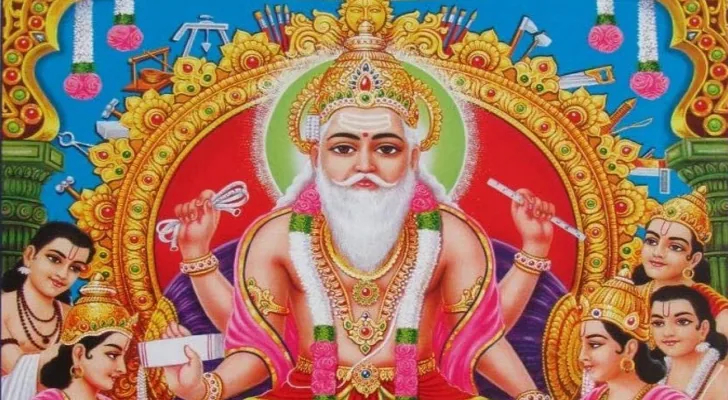
Lord Vishwakarma is revered as the deva-shilpi, the craftsman of the gods. He is usually shown with four arms and a white beard, holding tools such as a measuring rod, a water pot, a book and a noose. His vehicle is a swan, and in Bengal he is often shown with an elephant. His daughter Sanjna is married to Surya, the sun god.
When it is celebrated
The puja is usually held on Kanya Sankranti, which generally falls on 16, 17 or 18 September. In parts of North India it is observed on the day after Diwali, and some communities also celebrate Vishwakarma Jayanti on Magha Shukla Trayodashi.
Things needed for the puja
Common items include a picture or idol of Lord Vishwakarma, a chowki covered with a yellow or red cloth, a kalash with water, mango leaves and a coconut, roli, haldi, akshat, flowers and garlands, incense, a ghee lamp, camphor, fruits, sweets and panchamrit.
How the puja is done
People bathe and wear clean clothes. The workplace and tools are cleaned. The puja begins with a sankalp and the worship of Lord Ganesh, followed by kalash sthapana and the worship of Lord Vishwakarma. Tools and machines are then given tilak, flowers and akshat. The katha is read, the aarti is sung and prasad is shared.
Celebrations
Factories and workshops often hold community pujas with large decorated idols. Work stops for the day, and workers and their families enjoy the festival together. In Bengal and Bihar, the sky fills with colourful kites.
Importance
The festival teaches respect for labour and skill. It reminds people to look after their tools and machines and to work safely. It also brings employers and workers together in a spirit of gratitude.
Conclusion
Vishwakarma Puja celebrates the creativity and hard work that build homes, cities and industries. Its message that all honest work is worthy of respect is useful for students and adults alike.
Essay on Lord Vishwakarma as the divine architect
The name Vishwakarma means "the maker of all" or "the one who does all work". From the earliest Hindu texts to popular devotion today, Lord Vishwakarma has stood for the power of creation through skill. In the Rigveda, Vishvakarman is praised in two hymns of the tenth mandala as the all-maker who shapes heaven and earth. In later tradition, he came to be revered as the deva-shilpi, the architect and craftsman of the gods.
Many stories describe his work. According to tradition, he built Dwarka, the city of Lord Krishna by the sea, and the golden city of Lanka. He is credited with making the Pushpaka Vimana, a flying chariot, and with fashioning celestial weapons. One well-known story tells how he made Indra's Vajra, the thunderbolt, from the bones of the sage Dadhichi, who gave up his body so that the gods could defeat the demon Vritra. These stories present him as a master of planning, building and metalwork.
Lord Vishwakarma's family also appears in the Puranic stories. His daughter Sanjna is married to Surya, the sun god. In the Ramayana, Nala, who led the building of the bridge to Lanka, is described as a son of Vishwakarma, and many later craftsmen and builders were seen as his descendants or followers. This shows how closely his name is linked with craft.
Because of this, artisans, carpenters, smiths, masons, engineers and architects regard him as their patron deity. Many craft communities consider him their ancestor and guide. The traditional science of architecture and building, known as Vastu and Shilpa Shastra, is also associated with his name.
The idea of a divine architect gives dignity to practical work. It suggests that designing a building, forging a tool or repairing a machine can be a form of worship when done with care and honesty. This is why, on Vishwakarma Puja, people do not only pray to an image but also honour the tools in their own hands.
Essay on how Vishwakarma Puja is celebrated at workplaces
Most festivals are celebrated at home, but Vishwakarma Puja is celebrated mainly at the place of work. Factories, workshops, garages, printing presses, construction sites, electricity offices, railway sheds and small repair shops all take part. In many towns of eastern India, the day feels like a holiday for the whole industrial community.
Preparations start a few days earlier. Workers clean the floors, wash and oil the machines, repair small faults and decorate the premises with flowers, mango leaves, banners and lights. In larger factories, a pandal is set up and a clay idol of Lord Vishwakarma is brought in, often shown with his elephant. Smaller workplaces use a framed picture on a decorated chowki.
On the day, work usually stops. A priest or a senior worker performs the puja. After the worship of Lord Vishwakarma, each tool, machine and vehicle is given tilak, flowers and akshat. Drivers decorate their trucks, autorickshaws and buses, and mechanics arrange their spanners and drills neatly before the deity. The katha is read and the aarti is sung by everyone together.
After the puja, prasad is distributed to all workers and visitors. Many employers arrange a shared meal, and some give sweets or small gifts to their staff. In Bengal and Bihar, workers fly kites from rooftops in the afternoon. In some places, the idol is immersed in a river or pond the next day, after which work resumes.
The celebration at workplaces has a deeper value. It encourages cleanliness, regular maintenance and safety. It reminds everyone that machines and tools deserve care. Most of all, it brings owners, managers and workers together as one team, united by gratitude for the work that supports their families.
Read more
To learn more about the festival, read about the history of Vishwakarma Puja, its significance, the step-by-step puja vidhi and the Vishwakarma Puja katha.
यहाँ विद्यार्थियों और सभी पाठकों के लिए विश्वकर्मा पूजा पर पाँच निबंध दिए गए हैं: 150 शब्दों का छोटा निबंध, 300 शब्दों का निबंध, शीर्षकों वाला विद्यालय निबंध, दिव्य वास्तुकार भगवान विश्वकर्मा पर निबंध, और कार्यस्थलों पर पूजा कैसे मनाई जाती है, इस पर निबंध। इन्हें कक्षा के काम या भाषण के अनुसार ज्यों का त्यों या छोटा करके इस्तेमाल किया जा सकता है।
विश्वकर्मा पूजा पर छोटा निबंध (150 शब्द)
विश्वकर्मा पूजा देवताओं के दिव्य वास्तुकार और शिल्पी भगवान विश्वकर्मा को समर्पित हिंदू त्योहार है। उन्हें कारीगरों, इंजीनियरों, मैकेनिकों, कारखानों के कामगारों और औज़ारों व मशीनों से काम करने वाले सभी लोगों का आराध्य देव माना जाता है।
यह पूजा प्रायः कन्या संक्रांति के दिन होती है, जब सूर्य कन्या राशि में प्रवेश करता है। यह दिन प्रायः 16, 17 या 18 सितंबर को पड़ता है। पश्चिम बंगाल, ओडिशा, झारखंड, बिहार, असम और त्रिपुरा में इसे विशेष उत्साह से मनाया जाता है। उत्तर भारत के कुछ हिस्सों में विश्वकर्मा दिवस दीवाली के अगले दिन मनाया जाता है।
इस दिन कार्यशालाओं, कारखानों और दफ़्तरों की सफ़ाई और सजावट की जाती है। औज़ारों, मशीनों और वाहनों की पूजा होती है और आमतौर पर उस दिन काम बंद रहता है। पूजा और आरती के बाद सबमें प्रसाद बाँटा जाता है। यह त्योहार काम, हुनर और रोज़ी देने वाले औज़ारों के प्रति सम्मान सिखाता है।
विश्वकर्मा पूजा पर निबंध (300 शब्द)
भारत में अनेक त्योहार मनाए जाते हैं और हर त्योहार का अपना अर्थ है। विश्वकर्मा पूजा इसलिए ख़ास है क्योंकि यह स्वयं काम का सम्मान करती है। यह भगवान विश्वकर्मा को समर्पित है, जिन्हें देवताओं का वास्तुकार और अभियंता तथा शिल्पकारों और औद्योगिक कामगारों का आराध्य देव माना जाता है।
परंपरा के अनुसार भगवान विश्वकर्मा ने भगवान कृष्ण के लिए द्वारका नगरी, सोने की लंका और पुष्पक विमान का निर्माण किया। माना जाता है कि उन्होंने इंद्र के वज्र सहित कई दिव्य अस्त्र भी बनाए। ऋग्वेद के दसवें मंडल के दो सूक्तों में विश्वकर्मा की स्तुति सबके रचयिता के रूप में की गई है।
विश्वकर्मा पूजा प्रायः कन्या संक्रांति को मनाई जाती है, जो आमतौर पर 16, 17 या 18 सितंबर को पड़ती है। सौर पंचांग पर आधारित होने के कारण इसकी तारीख़ हर साल लगभग एक जैसी रहती है। यह त्योहार पूर्वी भारत, विशेषकर पश्चिम बंगाल, ओडिशा, झारखंड, बिहार, असम और त्रिपुरा में सबसे लोकप्रिय है, और देश भर के कारखानों व कार्यशालाओं में मनाया जाता है। पंजाब, हरियाणा, दिल्ली और हिमाचल प्रदेश में बहुत से लोग विश्वकर्मा दिवस दीवाली के अगले दिन, गोवर्धन पूजा के साथ मनाते हैं।
तैयारी सफ़ाई से शुरू होती है। कार्यस्थल, औज़ार और मशीनें धोई जाती हैं, उनमें तेल डाला जाता है और उन्हें फूलों से सजाया जाता है। भगवान विश्वकर्मा की तस्वीर या प्रतिमा चौकी पर रखी जाती है और फूल, धूप, दीपक, फल और मिठाई से पूजा की जाती है। कामगार अपने औज़ारों और मशीनों पर तिलक लगाते हैं और फूल व अक्षत चढ़ाते हैं। कथा पढ़ी जाती है, "ॐ जय श्री विश्वकर्मा" आरती गाई जाती है और प्रसाद बाँटा जाता है। बंगाल और बिहार में इस दिन पतंग उड़ाने का भी चलन है।
यह त्योहार याद दिलाता है कि हर तरह का काम सम्मान के योग्य है। यह औज़ारों की देखभाल, काम के समय सुरक्षा और साथ काम करने वालों में एकता की भावना को बढ़ावा देता है।
विद्यार्थियों के लिए विश्वकर्मा पूजा पर निबंध
प्रस्तावना
विश्वकर्मा पूजा दिव्य वास्तुकार भगवान विश्वकर्मा के सम्मान में मनाया जाने वाला हिंदू त्योहार है। यह उन गिने-चुने त्योहारों में से है जिनमें औज़ारों, मशीनों और कार्यस्थलों की पूजा होती है, और पूरे भारत में कामगार, इंजीनियर और कारीगर इसे बड़े चाव से मनाते हैं।
भगवान विश्वकर्मा कौन हैं?
भगवान विश्वकर्मा को देवशिल्पी, यानी देवताओं का शिल्पकार माना जाता है। उन्हें प्रायः चार भुजाओं और सफ़ेद दाढ़ी के साथ दिखाया जाता है, और उनके हाथों में नापने का गज़, जल पात्र, पुस्तक और पाश जैसे उपकरण होते हैं। उनका वाहन हंस है, और बंगाल में उन्हें अक्सर हाथी के साथ दिखाया जाता है। उनकी पुत्री संज्ञा का विवाह सूर्य देव से हुआ।
कब मनाई जाती है
यह पूजा प्रायः कन्या संक्रांति को होती है, जो आमतौर पर 16, 17 या 18 सितंबर को पड़ती है। उत्तर भारत के कुछ हिस्सों में इसे दीवाली के अगले दिन मनाया जाता है, और कुछ समुदाय माघ शुक्ल त्रयोदशी को विश्वकर्मा जयंती भी मनाते हैं।
पूजा की सामग्री
आम सामग्री में भगवान विश्वकर्मा की तस्वीर या प्रतिमा, पीले या लाल कपड़े से ढकी चौकी, जल से भरा कलश, आम के पत्ते और नारियल, रोली, हल्दी, अक्षत, फूल और मालाएँ, धूप, घी का दीपक, कपूर, फल, मिठाई और पंचामृत शामिल हैं।
पूजा कैसे होती है
लोग स्नान करके साफ़ कपड़े पहनते हैं। कार्यस्थल और औज़ारों की सफ़ाई की जाती है। पूजा संकल्प और गणेश पूजन से शुरू होती है, फिर कलश स्थापना और भगवान विश्वकर्मा की पूजा होती है। इसके बाद औज़ारों और मशीनों पर तिलक लगाकर फूल और अक्षत चढ़ाए जाते हैं। कथा पढ़ी जाती है, आरती गाई जाती है और प्रसाद बाँटा जाता है।
उत्सव
कारखानों और कार्यशालाओं में अक्सर सामूहिक पूजा होती है और सजी हुई बड़ी प्रतिमाएँ स्थापित की जाती हैं। उस दिन काम बंद रहता है और कामगार अपने परिवारों के साथ त्योहार का आनंद लेते हैं। बंगाल और बिहार में आसमान रंग-बिरंगी पतंगों से भर जाता है।
महत्व
यह त्योहार श्रम और हुनर का सम्मान करना सिखाता है। यह याद दिलाता है कि औज़ारों और मशीनों की देखभाल करनी चाहिए और सुरक्षित ढंग से काम करना चाहिए। यह मालिकों और कामगारों को कृतज्ञता की भावना से एक साथ भी लाता है।
उपसंहार
विश्वकर्मा पूजा उस रचनात्मकता और मेहनत का उत्सव है जिससे घर, शहर और उद्योग बनते हैं। इसका संदेश कि हर ईमानदार काम सम्मान के योग्य है, विद्यार्थियों और बड़ों दोनों के लिए उपयोगी है।
दिव्य वास्तुकार भगवान विश्वकर्मा पर निबंध
विश्वकर्मा नाम का अर्थ है "सब कुछ रचने वाला" या "जो सारे कर्म करता है"। प्राचीन ग्रंथों से लेकर आज की लोक भक्ति तक, भगवान विश्वकर्मा हुनर के माध्यम से सृजन की शक्ति के प्रतीक रहे हैं। ऋग्वेद के दसवें मंडल के दो सूक्तों में विश्वकर्मा की स्तुति उस सर्वस्रष्टा के रूप में की गई है जो धरती और आकाश को आकार देता है। बाद की परंपरा में उन्हें देवशिल्पी, अर्थात देवताओं के वास्तुकार और शिल्पकार के रूप में पूजा जाने लगा।
उनके कार्यों से जुड़ी अनेक कथाएँ हैं। परंपरा के अनुसार उन्होंने समुद्र के किनारे भगवान कृष्ण की नगरी द्वारका और सोने की लंका बसाई। पुष्पक विमान और कई दिव्य अस्त्रों के निर्माण का श्रेय भी उन्हें दिया जाता है। एक प्रसिद्ध कथा के अनुसार उन्होंने महर्षि दधीचि की अस्थियों से इंद्र का वज्र बनाया। महर्षि दधीचि ने अपना शरीर इसलिए त्याग दिया था ताकि देवता वृत्रासुर को पराजित कर सकें। ये कथाएँ उन्हें योजना, निर्माण और धातु कला के महान आचार्य के रूप में प्रस्तुत करती हैं।
पौराणिक कथाओं में भगवान विश्वकर्मा के परिवार का भी उल्लेख मिलता है। उनकी पुत्री संज्ञा का विवाह सूर्य देव से हुआ। रामायण में लंका तक सेतु बनाने का नेतृत्व करने वाले नल को विश्वकर्मा का पुत्र बताया गया है, और बाद के अनेक शिल्पियों और निर्माताओं को उनका वंशज या अनुयायी माना गया। इससे पता चलता है कि उनका नाम शिल्प से कितनी गहराई से जुड़ा है।
इसी कारण कारीगर, बढ़ई, लोहार, राजमिस्त्री, इंजीनियर और वास्तुकार उन्हें अपना आराध्य देव मानते हैं। अनेक शिल्पी समुदाय उन्हें अपना पूर्वज और मार्गदर्शक मानते हैं। वास्तु और शिल्प शास्त्र के नाम से जानी जाने वाली स्थापत्य और निर्माण की पारंपरिक विद्या भी उनके नाम से जुड़ी है।
दिव्य वास्तुकार की यह धारणा व्यावहारिक काम को गरिमा देती है। इससे यह भाव मिलता है कि भवन की रूपरेखा बनाना, औज़ार गढ़ना या मशीन ठीक करना भी पूजा के समान है, यदि वह लगन और ईमानदारी से किया जाए। इसीलिए विश्वकर्मा पूजा पर लोग केवल प्रतिमा की ही नहीं, बल्कि अपने हाथ के औज़ारों की भी पूजा करते हैं।
कार्यस्थलों पर विश्वकर्मा पूजा कैसे मनाई जाती है, इस पर निबंध
अधिकतर त्योहार घर पर मनाए जाते हैं, पर विश्वकर्मा पूजा मुख्य रूप से काम की जगह पर मनाई जाती है। कारखाने, कार्यशालाएँ, गैराज, छापेखाने, निर्माण स्थल, बिजली दफ़्तर, रेलवे शेड और छोटी मरम्मत की दुकानें, सभी इसमें भाग लेते हैं। पूर्वी भारत के कई शहरों में यह दिन पूरे औद्योगिक समुदाय के लिए छुट्टी जैसा होता है।
तैयारी कुछ दिन पहले से शुरू हो जाती है। कामगार फ़र्श साफ़ करते हैं, मशीनें धोकर उनमें तेल डालते हैं, छोटी-मोटी ख़राबियाँ ठीक करते हैं और परिसर को फूलों, आम के पत्तों, झंडियों और रोशनी से सजाते हैं। बड़े कारखानों में पंडाल बनाया जाता है और भगवान विश्वकर्मा की मिट्टी की प्रतिमा लाई जाती है, जिसमें अक्सर उनके साथ हाथी भी होता है। छोटे कार्यस्थलों पर सजी हुई चौकी पर तस्वीर रखी जाती है।
पूजा के दिन आमतौर पर काम बंद रहता है। कोई पुरोहित या वरिष्ठ कामगार पूजा करता है। भगवान विश्वकर्मा की पूजा के बाद हर औज़ार, मशीन और वाहन पर तिलक लगाकर फूल और अक्षत चढ़ाए जाते हैं। चालक अपने ट्रक, ऑटो और बसें सजाते हैं, और मैकेनिक अपने रिंच और ड्रिल भगवान के सामने करीने से रखते हैं। सब मिलकर कथा सुनते हैं और आरती गाते हैं।
पूजा के बाद सभी कामगारों और आगंतुकों को प्रसाद दिया जाता है। बहुत से मालिक सामूहिक भोजन की व्यवस्था करते हैं, और कुछ अपने कर्मचारियों को मिठाई या छोटे उपहार देते हैं। बंगाल और बिहार में दोपहर को कामगार छतों से पतंग उड़ाते हैं। कई जगह अगले दिन प्रतिमा का नदी या तालाब में विसर्जन किया जाता है, जिसके बाद काम फिर शुरू होता है।
कार्यस्थलों पर होने वाले इस उत्सव का गहरा महत्व है। यह सफ़ाई, नियमित रखरखाव और सुरक्षा को बढ़ावा देता है। यह सबको याद दिलाता है कि मशीनें और औज़ार देखभाल के पात्र हैं। सबसे बढ़कर, यह मालिकों, प्रबंधकों और कामगारों को एक टीम के रूप में जोड़ता है, जो उस काम के प्रति कृतज्ञ हैं जिससे उनके परिवार चलते हैं।
और पढ़ें
इस त्योहार के बारे में और जानने के लिए विश्वकर्मा पूजा का इतिहास, इसका महत्व, क्रमवार पूजा विधि और विश्वकर्मा पूजा कथा पढ़ें।